A BLAST FROM THE PAST: WHY THE CIRCUIT LEFT KILLARNEY
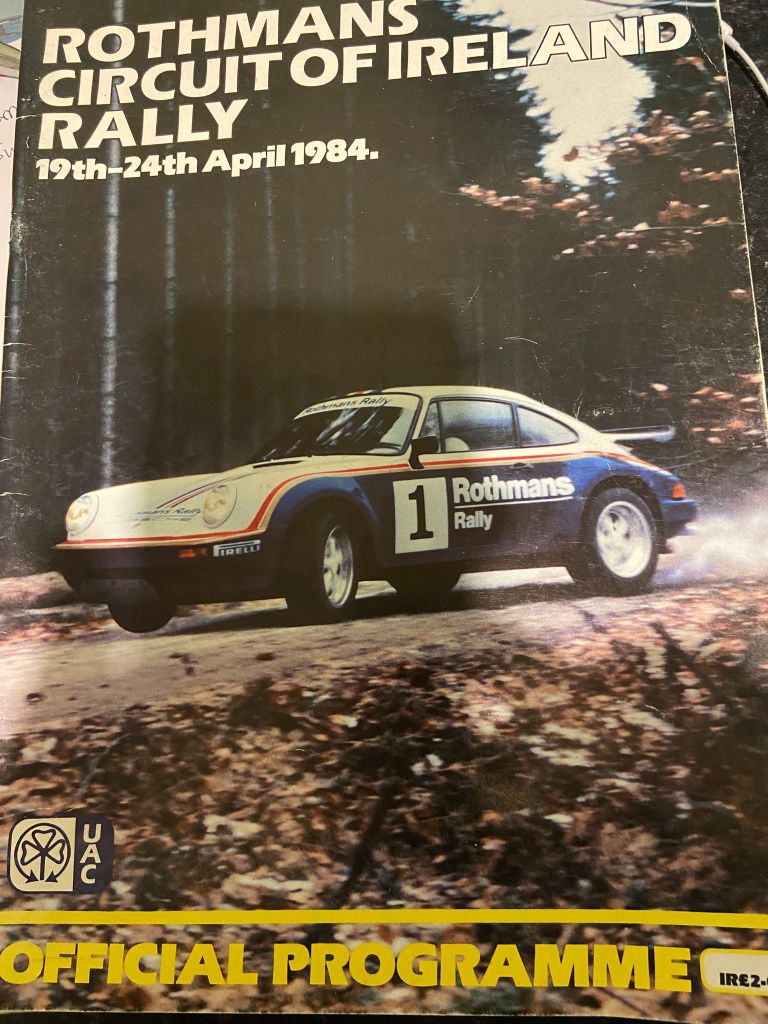
While digging through the archives, we found a rare copy of the 1984 Circuit of Ireland Rally programme. Exactly 42 years old today, it contains a fascinating piece by the legendary Sammy Hamill on why Killarney lost the event.
1984 marked the first year the rally moved its headquarters to Waterford, ending a long-standing era for Kerry motorsport. Sammy’s story offers a deep dive into the politics and logistics that shifted the “Circuit” away from its traditional home.
BY SAMMY HAMILL (Belfast Telegraph)
Spectators crowd the famous Moll’s Gap stage in 1981, now fallen to the wind of change.
The Circuit of Ireland, Easter and Killarney have gone together for the best part of 50 years – like Christmas and turkey, Scotland and whisky, Torvill and Dean. But no more.
Waterford may not conjure up the same visions and memories as Easter Sunday around the Ring of Kerry but in the ways of a world in which everything changes eventually, there will be no Killarney this year, no Great Southern Hotel, no Moll’s Gap.
On a rally like the Circuit of Ireland traditions appear to be hard and even if the time has been ripe for a move out of over-rates and over-priced Killarney, it took a brave decision to change half a century of history.
Clerk of the Course, Donald Grieve, ma
de that decision almost a year ago, ruffling a few feathers and sparking off thousands of words of comment, some good, some bad. It even prompted a cartoon in the Irish Times, depicting a crossroads with a signpost pointing the ways to Killarney and Waterford. “Killarney X miles,” it said. “Waterford miles cheaper.”
Wishful thinking, perhaps, but getting the point across nevertheless. Killarney not only priced itself out of the Circuit market but equally importantly refused to give back more than a meagre share of the take. They did that in the certain belief that the Circuit would keep on coming back. They were wrong, I’m happy to say, and Grieve courageously broke with a tradition which started back in 1936 with the first full Circuit of Ireland.
The route of just over 1000 miles that year allowed for a days rest in Killarney but crews were warned beforehand that a teachers’ conference was being held in the town and that accommodation could prove to be a problem. The teachers, I would guess, have not returned to Killarney at Easter since although there should be ample rooms available for them now.
So much so that I notice from advertisements and the tourist guide that hotels are offering a three-night holiday weekend package cheaper than they charged for two nights last year. Waterford, incidentally, certain that their limited accommodation would be fully booked, offered no price quotations in the Bord Failte guide.
But perhaps had the powers-that-be in Killarney known their Circuit history better, they may have paid more heed to the warning signs in recent years.
Just prior to the war, it was Cork where the Circuit paused for its overnight halt and passed through the Co. Kerry countryside without wasting any time in Killarney town itself. That’s a plan I would settle for today.
In fact it wasn’t until the fifties that Killarney was adopted as the rally’s southern base and despite its outward appearance as an “institution” of Irish motorsport, the Circuit of Ireland has undergone constant and sometimes radical changes.
It hasn’t always lasted for five days; it hasn’t always started in Belfast; it hasn’t always been decided on special stages; it hasn’t always been a major championship event; it hasn’t always been held at Easter and even its name hasn’t been the same.
Originally called the Ulster Motor Rally when it was first held back in August 1931, it became the Circuit of Ireland Trial when it first adopted an all-round Ireland format in 1936. It wasn’t until 1956 that it became a rally.
It has changed too from a gentle jaunt around Ulster with a single regularity test to decide the winner to its current concept of 500 or more miles of flat-out driving, ranging through the whole gambit of motoring in between. Navigation, driving tests, speed tests, hillclimbs and more than its share of novelty exercises as well.
The most odd of these could well have been the “slow 50 yards,” otherwise known as the flexibility test used in 1950. The idea was to drive down a 50-yard stretch of road in top gear taking as long as possible without actually stopping. The driver couldn’t weave about either, a rope being stretched down the centre with the cars starting with two wheels on either side of it. Use of the clutch and brakes were also ruled out.
Dermot Johnson took 30 seconds to do it in his V8 Allard and thereafter was never seriously challenged on his way to victory.
Then there was the year, 1954, that Gordon Neill introduced a tough navigation section right from the start instead of in Kerry as had been the pattern. It eliminated nearly half the field in the first few hours. One driver, Sammy Taylor, threw the envelope containing his route instructions into the back of the car and headed straight for Athlone. He thought the envelope contained his tickets for the dance on Tuesday night! He, too, paid the price for taking the Circuit of Ireland and the Ulster Automobile Club for granted.
Neill became famous (infamous?) for his tricky innovations, once misleading half the field into trying to cross a mountain in search of Gouganebarra when only a goat track existed. A total of 54 crews incurred massive penalties, including as a writer of the time said “some who were well-known to fame.”
It was Neill who introduced a handicap system to try to even the balance between sports and saloon cars, who excluded specials from the competition and who established the rally as a major sporting contest instead of the weekend motoring holiday it had once been.
But it was another Clerk of the Course, Count Robin McKinney, himself a two-time winner of the event, who altered the face of the Circuit of Ireland completely. He brought it right up to date by introducing special stages and even allowing pace notes for a time.
He did away with driving tests and navigation sections and produced the first “special stage” rally.
It was Grieve, his nephew, who thought of turning the first day of the rally into a concentrated Northern Ireland section and he also broke with a more recent tradition to introduce more notes in the areas of the rally controlled by the RAC.
And it was Grieve, too, who had to face one of the toughest decisions in the history of the event when he gave the go-ahead to the 1979 rally despite a major fuel shortage in the south of Ireland. Worse still, supplies which were promised to be available in Galway failed to materialise and for several hours in the middle of the night it seemed the whole rally would come to a halt.
The wisest thing it seemed would be to turn north again and head for home but Grieve kept his nerve and directed the rally on southwards towards Killarney.
The considerable political clout of the rally was brought into force and petrol supplies suddenly became available from Limerick onwards.
That same pressure was used many years earlier during a spell of petrol rationing soon after the war when motorists were allowed 33 gallons for the first six months of the year yet competitors on the rally were allocated 35 gallons for the four days.
With that kind of background and previous trials by fire, it was Killarney who made a grave error in judgment in deciding to call Grieve’s bluff. They reckoned he wouldn’t move the Circuit out of Killarney but they were wrong.
The decision to move to Waterford, for better or for worse, was made in the spirit which has kept the Circuit of Ireland alive for more than 50 years. And that same spirit may be called on in the near future to take other far-reaching decisions about the fate of the rally.
In some ways it is an anachronism. It is too long, too expensive. A world championship event without official status. It is reaching beyond the circumstances of average competitors, a fact reflected in the quantity if not the quality of this year’s entry list.
Soon some hard decisions are going to have to be taken. A shortening of the route? A reduction in the number of days?
On the other hand are those who see a different future in which, with the blessing of the RAC, pace notes would be permitted for the whole event and a change of date away from Easter could put the rally in line for consideration as a round of the World Championship.
Unlikely? Perhaps, but not inconceivable.
There are those outside the British Isles who would not be unhappy if the RAC Rally was removed from the championship, based on the “blind stages” format that it is, and the Circuit of Ireland could be a viable alternative.
The sceptics who dismiss such a possibility will probably be right. But on the other hand they probably made their 1984 bookings in Killarney when they were there last year.
Just as newspapers and magazines are paid for, digital editorial content will also have to be paid for.
Please subscribe and help us keep this machine running!
It’s only €50 per year – subscribe now
Subscribe to get access
Read more of this content when you subscribe today.


