
Time Table
Sign on from 10am at Rose Hotel
Entry fee by donation – proceeds to a local charity
Depart 1130am
140kms
Lunch halt at the Café at Four Paek Business Park in Faranfore from 1pm
Refuel at the Four Elms Pub at Lyrecrompane around 330pm
Club social night in Sean Ogs from 8pm
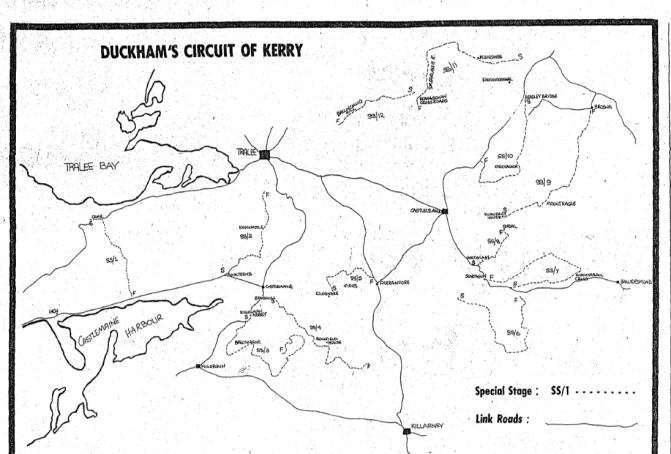
Not all stages of the original route can be used on Saturday due to the length of the route – those marked in bold below will feature
Reeling in the Years
By Mike Marshall clerk of the course 1975 Circuit of Kerry
The first Circuit of Kerry was originally scheduled to take place on Sunday April 27th 1975 but strike by tanker drivers cause a fuel shortage throughout the country so the event had to be postponed until May 18th.
Based in the Mount Brandon Hotel Tralee, the main sponsor was Duckhams, who gave eighty pounds to KMC for the right to be the title sponsor.
The entry fee was ten pounds and the overall winner received a cheque for one hundred pounds.
While these figures may sound insignificant nowadays it should be realised that the main sponsor gave the equivalent of eight entry fees and the winners cheque represented ten times the entry fee so if we project that forward to present day events the winner would be getting paid up to ten thousand pounds on national rallies and significantly more on the internationals.
The rally had 12 separate stages, all run just once and covering an area of the county from Camp in the west and east almost to the county bounds near Ballydesmond.
The idea of manning twelve stages in a single day is mind boggling nowadays, nor would any club be permitted to plan such a rally.
However, things were far simpler then.
It helped greatly that the single use of each stage meant that individual stages were not closed for long periods.
On most stages the road closed time was three hours give or take a few minutes.
Every stage had a Start Time Keeper, in some cases operating alone and while the Finish Timekeeper had to have a helper, there was very little manpower in between.
There were no radios, mobile phones or trackers, yet no stage was cancelled and the event ran on time throughout the day.
Generally a local person was recruited to perform the dual function of sealing the exit of the stage and directing the rally cars out onto the main road.
Sealing the Stage Entrance/ Start was a far simpler matter as the idea of going 400 yards off the open road had not yet raised its head so the stage started immediately that the cars turned in off the open road.
The Start Timekeeper effectively controlled entry to the stage by standing in the middle of the road until a rally car arrived, with a start time being immediately entered on the crews timecard and away they went.
A 400 yard dead zone was irrelevant as we had nothing to park there since there were no ambulances, no doctors, no rescue or recovery crews or no Stage Arrival Control.
Road timing operated on the basis that a due time for the first car at each stage was published and each crew would calculate its own due time by dividing their competition number by two and adding that number of minutes to the first car due time.
Timing was tight so it was most unlikely that anyone would arrive early.
For example, cars had just eighteen minutes from the Start of SS1 to complete the tricky Camp Mountain stage and the following road section from Aughills to the Start of SS2 at what is now the Anvil Bar in Boolteens.
Unless one lost time on the stage or had to carry out emergency repairs on the road section, everybody tried to hold their place in the running order by arriving on time at the stage start.
Indeed, I cannot recall any road penalties being applied for lateness as the whole principle on which the rally operated was that you had to get a time on every stage while the road was closed.
Quite a few of the stages which made up the first Circuit of Kerry have been used in one format or other on several events since 1975 so let us look at those stages which made up that initial venture into organising a rally in Kerry by a home based motor club.
SS1 Camp Mountain.
The passage of 50 years has left a doubt in my mind as to which of two alternative starts for this stage was finally used.
The original plan was to start at the church at the crossroads in Camp village and go straight over Bothar na Gloc to Aughills, but the enforced change to the May date meant that the Start would be too close to the church where there was a Confirmation or First Communion due to take place.
The alternative was to start up beside what used to be the local dispensary building at the sharp bridge on the Tralee side of Camp and rejoin the original stage beyond Joe Moynihan’s house at Killteenbawn.
One of the features of original version was a square left at an old coachyard wall at Moynihan’s where Joe had agreed to open the gate and tidy up the abandoned cars and machinery in the yard to provide an escape for drivers who arrived too quickly and opted for straight on!
From the top of the climb over Caherconree it was downhill all the way to the finish on road which was narrow, bumpy and without any protection on the right hand side.
It was one of those stages which, if run nowadays, would have called for several chicanes but, even if the curse of chicanes existed fifty years ago, there would not have been room for any form of chicane.
Like another well-known stage, Knockacullig, if you went off you would be rolling and dropping for a long time before you eventually came to a halt.
There were a few retirements on SS1, caused primarily by mechanical problems which are not unusual on the first stage of any rally, but the only other incident of note involved a local driver who was in the motor trade and who “borrowed” a customer’s Cortina which was in for some service or repairs and promptly rolled it into a ball!
When one considers that Inertia Reel seat belts were acceptable, roll cages were not mandatory, nor were fire retardant suits, balaclavas or gloves, laminated windscreens or on-board fire extinguishers, it is remarkable that the only injuries incurred in off road excursions were to the drivers pride and pocket!
SS2 Knockmoyle
Taking its name from the mountain which effectively separates the Tralee side of the Dingle Peninsula on the north from the Castlemaine side on the south, this road is more commonly known as the Short Mountain and has been a regular stage in events including an early Circuit of Ireland and in a good few years of the Circuit of Kerry
Start line was at what is now the Anvil Bar in Boolteens , known at that stage by one or other of the various names under which it traded over a long history of hospitality.
Very few marshals were needed as the local residents all looked after their own entrances so no motor club marshals we required until the crossroads where the stage goes left over the Short Mountain.
Easily accessible from the Castlemaine to Tralee road, the location had a sizeable number of spectators for whom the action got increasing more exciting as each passing Mini threw out a good splash of petrol making road conditions more tricky for the subsequent cars. Yellow flags or other warning devices were not even thought of then.
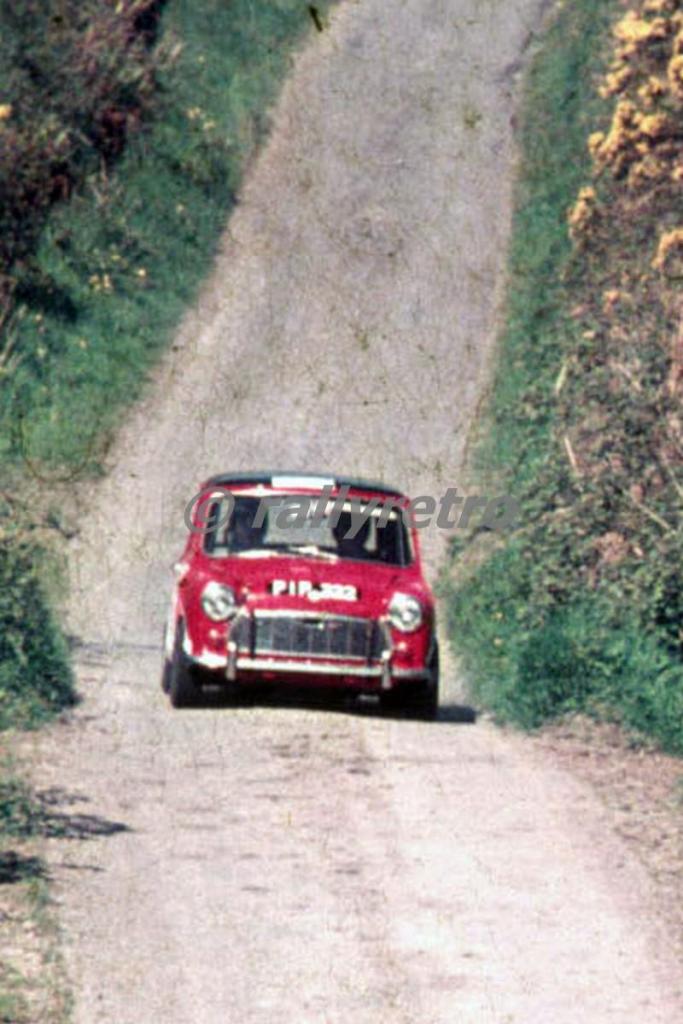
Apart from the petrol spraying performance the other memory of the Minis was the distinctive smell of Castrol R, the special engine oil without which no serious Mini Driver would venture to an event.
From the top to the Finish was downhill and narrow with the cars being timed on sight as they turned right onto the T road at the end. Stopping distance was quite short as we reasoned that drivers would be down to first gear to safely negotiate the corner at the Finish.
A local had been recruited to direct the cars out onto the Tralee to Castlemaine road at the crossroads on a blind bend and he also ensured that nobody got back in to the Stop Car.
The road section through Castlemaine and Milltown to SS3 Ballyvirrane was one of the longest in an event where distances between stages were, where possible, kept to a minimum.
SS3 Ballyvirrane
One of the longest stage in the event and one where quite a few marshals had to be recruited, mainly by local competitors such as the O’Neills, Riordans and Buckleys.
The stage started at the Knockavota road, opposite the Milltown graveyard and recent road re-alignment might make it difficult to establish the exact location.
It then continued via Dromin, Ballyvirrane and Nauntinan , past the entrance to Kerry Woollen Mills at Ballymalis and then left to Listry Cross.
Common sense and present day thinking would say that the stage should have finished at that point but that was then and we could do things then which would be unthinkable nowadays.
Notwithstanding the fact that we were crossing the main Killarney to Dingle road we carried on , turning left at Listry Cross and over Listry Bridge before turning right beside the old creamery a short distance later.
A fairly short but very tight loop followed around Lisheenshingane before the Finish at Lissavane.
Apart from closing a major road for three hours, which would nowadays be considered impossible, it would be deemed unwise to add a tight section at the end of a long stage.
Nevertheless we did both and there was no public outcry and only one competitor, Frank O’ Mahony in a Tiger Avenger was delayed when he caught a slower car on the final half mile of the stage.
A virtually identical stage, without the Lisheen Loop, was run in reverse, starting from Listry Church in the Killarney Historic Rally a few years ago and given the level of farming activity in the area some of the roads proved to be still as slippery as they were back in 1975
After 3 stages the time cards were collected in Milltown where time was relaxed for service.
Not that there was any designated service area as one was free to service in any location where one did not cause an obstruction or create a danger to themselves or others.
The idea of strictly controlled service areas with controls in and out was a feature which I cannot recall seeing even on the Circuit of Ireland in those days and refuelling zones were interpreted as the nearest pub.
SS4 Rockfield House
The map published in the Kerryman of April 25th 1975 shows the Rockfield House stage as
per the road closing orders published by Kerry County Council and this indicates that the start would be off the Castlemaine to Farranfore road at Ardmelode, but during the delay caused by the fuel shortage we decided that we would add a section at the start of the stage by starting beside Milltown Mart on the edge of the village and going via Glenellen and through Kilcrohane Wood to join the original stage just after the Start, meaning that no alteration to the Road Closing Order was required.
The fact that the stage went from tarmac to gravel and then back to tarmac was perfectly acceptable in those days and indeed I recall doing several Moonraker rallies in Cork where the majority of the stage would be on gravel but it was quite normal to exit a forestry gate, still at full speed, travel for a mile or so along a tarmac road and then in another forest gate to a further gravel section, still on the same stage.
The gravel roads in Kilcrohane Wood, famous for its Penal Mass Rock, form a loop around the four sides of the wood and were used as a gravel single stage by Killarney and District Motor Club some years later and an early Circuit of Ireland also ran through the wood as part of a stage into or out of Milltown.
I recall seeing Malcolm Wilson in the Total Gold sponsored Escort in Milltown that year.
The original Tarmac version of Rockfield as used in the Circuit of Kerry 75 is now a regular feature of both the Rally of the Lakes and the Killarney Historic Rally with a good variety of road combinations making it an ideal final stage for events due to its capacity to soak up spectators at its many accessible junctions.
SS5 Molahiffe Castle
We had a policy of avoiding long road sections and where possible a short stage would be introduced to break up the road section.
Molahiffe Castle was one such stage in that it was quite short and the final section , known locally as “Feathermans Road” was narrow, bumpy, ran through a bog with unguarded verges and had at least two nasty skew bridges but luckily it passed off without accident and brought the crews onto the old, now disused, road at the Tralee side of the level crossing inn Farranfore. It has never been used since that initial effort.
From there it was on to one of the longest stages of the event at Kilsarkan.
SS6 Kilsarkan
Starting at Shanawillen Cross this was real rallying territory which had seen action in the Circuit of Ireland and 1972 Killarney Easter Rally and still sees regular use, in a variety of combinations and permutations of all these roads, in both the Lakes and Historic Rallies.
The residents were well disposed and welcoming towards rallying, again helping to alleviate the problem of finding sufficient marshals to man what is a labour intensive stage with multiple junctions.

SS7 Knocknaboul
From the Finish of Kilsarkan to the Start of Knockaboul involved only a short distance and crossing the main Scartaglen to Ballydesmond road to get the race under way again.
This was a fast stage with a good few straights and did not prove to have much appeal for drivers and obviously less for organisers as it has never been used in any rally since .
The stage finished almost into the village of Scartaglen, where there was a further opportunity to service cars after two long and testing stages.
A short distance along the main road towards Castleisland brought the cars to Stage 8, Gortglass.
SS8 Gortglass
The shortest stage in the event and one which was an organisers dream in that, apart from Start and Finish timekeepers, only a single solitary marshal was needed to man the stage.
This lone soldier was in charge of the crossroads at the back of Cordal Church, almost at the end of the stage, with local residents each looking after his/her own gates and entrances
While the stage times of the top competitors were too close to make any significant difference in the overall result, the stage served the very useful purpose of getting the rally close to the start of the next stage, without having to take the long way around through Castleisland.
We always believed that the fastest way to cover any distance from A to B was to rally it.
Nowadays running Gortglass would require about 20 marshals including timekeepers and the stage would end up almost a kilometre shorted due to the mandatory dead zones before the start and after the finish. Radios would have to be provided at Start, Midpoint and Finish
A full array of services including Doctor, Ambulance , Rescue and Recovery would also be required, making it illogical to assign that level of resources for so few competitive miles.
SS9 Mount Eagle
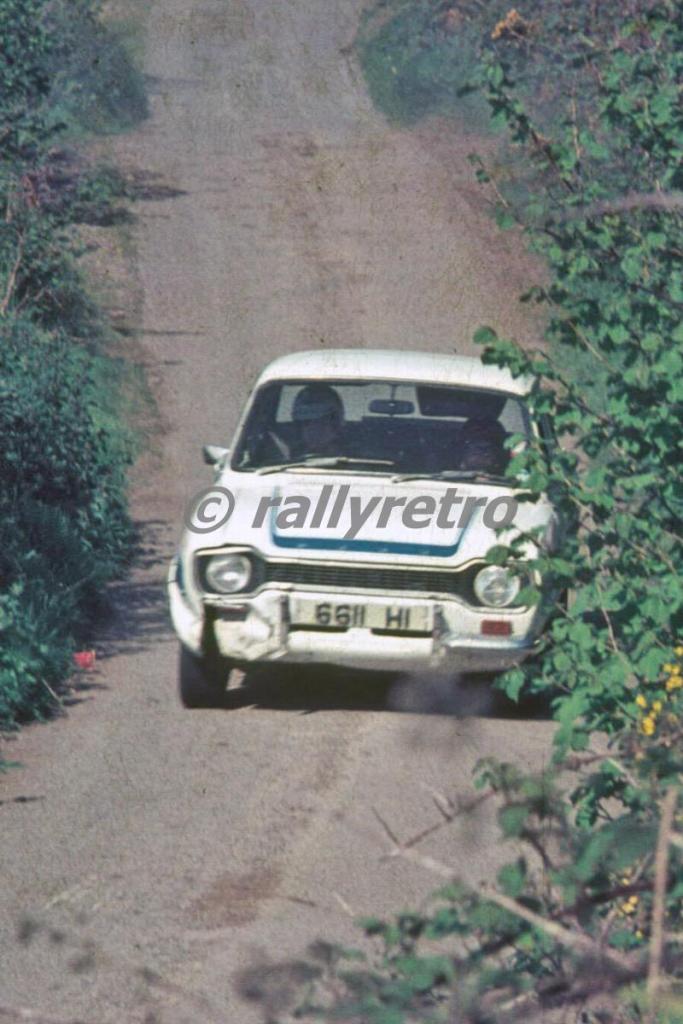
One of the great classic stages of Kerry it was a long time stable in the Circuit of Ireland and also featured in the Killarney Easter Rally, run by the Limerick Motor Club in 1972 when the Circuit of Ireland was cancelled at the height of the sectarian strife in Ulster.
Back then much of the stage was on gravel, as indeed it was in 1975 when it was included in the first Circuit of Kerry, but in those days tyres and suspensions were reasonably tolerant of such a variety of surfaces.
With very few houses and just a small number of junctions it was not labour intensive and neither was much arrowing required as, after the first fork right onto the gravel section, it was a straight run all the way to the Finish near the village of Brosna.
The construction of a major windfarm and extensive forestry in the area means that the former gravel roads are now tarmac and the stage has been used by Kerry Motor Club on the Circuit of Kerry a number of times while the forestry roads in Mounteagle have been used by both Limerick and Killarney clubs in forestry rallies in recent years.
As was the case from the start of the rally, Ger Buckley and John Caplice in their Ford Escort continued to consolidate their position at the head of the leader board,
SS10 Knockachur
The roads in this area have been a regular feature on several Kerry Motor Club rallies over the years but are normally listed as Talbots Bridge, Headleys Bridge or Crinny Mountain.
Back in 1975 the final section of the stage at Crinny did not appear on the Ordnance Survey maps but its existence was pointed out by local club members Dick McCarthy and John Walsh.
These few miles are among the most testing of any stage in the county and are both safe and were, in 1975, sparsely populated, which is always welcome when planning a rally.
No change at the top of the leaderboard with Buckley powering ahead with Demi Fitzgerald/ Sam Hawkins secure in second and a hard charging Greg O’Gorman/Leo Whyte third in a Renault Alpine A110, a car which was not ideal for some of the stages.
SS11 Smearlagh River
While the classic section of the stage from the junction near Lyre Post Office has been used many times in the Circuit of Kerry over the past five decades there have been several different combinations of roads used to get to Lyre
The construction of the new Castleisland to Abbeyfeale road and the Underpass have opened up further possibilities to reconfigure the many great rally roads in the area and provide a stage which can stand out among any in the country.
SS12 Ballincollig Hill
Ger Buckley started the final stage with a commanding lead but when the first car emerged from the end of the stage near Kielduff Creamery it was not the Banteer crew..
It had all come to a disappointing end when an oil pipe burst, forcing instant retirement and handing a very surprised Demi Fitzgerald a win, when he had accepted that what he needed to do was preserve his second place.
Greg O’Gorman/Leo Whyte were now second in their Renault Alpine A110 with another Renault variant, the R12 Gordini of Wally Hill/Michael Daly third, in what was probably the only occasion in Irish rallying where Renaults took two of the top three places.
Paddy O’Callaghan in a Audi 80GT followed home in fourth place having started at 22.
It was a disappointing exit for Buckley and in fact the stage itself was a disappointment which the rally would have been better off without.
The original plan was to come off the end of Smearlagh River, literally cross the road and immediately start Desmond’s Grave beside the ruins of the dance hall owned by Dan Paddy Andy, the matchmaker made famous by John B Keane .
Unfortunately a minor landslide on Desmond’s Grave in early April had caused a section of the road to subside so there was no question of being allowed to use this classic stage as the finale to the event.
In hindsight it was a mistake to turn right at Reenagown Cross and go the short distance to the start of Ballincollig Hill.
I have always believed that it is important to finish a rally with a really good stage as it is that stage which stays in the memory of those who finish the event.
Desmond’s Grave would have fitted that criteria or it may have been better to blow the final whistle at the end of Stage 11, as both Smearlagh River and Desmonds Grave are classics and Ballincollig Hill was most certainly not.
However we had promised twelve stages, so twelve stages would be delivered!
I have used that road over the past thirty tears getting to and from the Lee Strand Windfarm at Ballincollig Hill for the annual maintenance and testing shutdown and I still cannot believe that we actually ran a stage on such a road.
It was rough, bumpy and narrow fifty years ago and it has improved little if any in the intervening half century.
Not surprisingly, we are most unlikely ever again to see a Ballincollig Hill stage but one can only be grateful that nobody went off in a big way to blot the copy book of what had been an accident free event.


With the benefit of hindsight we can see that much of what we attempted, and got away with, was hard to believe but we can equally take pride in the fact that what was started back in 1975 has survived over the past fifty years and is still strong and vibrant in 2025.
It has survived internal friction in the club, enforced cancellations caused by Foot & Mouth, Covid and Insurance and some regrettable accidents.
It has had to deal with the imposition of ill-conceived regulations, many of which were a hindrance rather than a help to the sport and it has seen also the direct reversal of many of these unworkable edicts.
Above all it has shown that what is vital to the wellbeing of Irish rallying is that there are still volunteers willing to devote their time to organise rallies which utilise the stages and facilities which we have and who never lose sight of the fact that clubmen make up the greater part of our entry lists, contribute most to making the event financially viable, and must never be excluded from the sport by the pursuit of high profile aspirations.




Just as newspapers and magazines are paid for, digital editorial content will also have to be paid for.
Please subscribe and help us keep this machine running!
It’s only €50 per year – subscribe now
Subscribe to get access
Read more of this content when you subscribe today.

 Kerry Motorsport News